This is a list of the bird species recorded in Vietnam. The avifauna of Vietnam include a total of 963 species, of which 18 are endemic, and 5 have been introduced.
This list's taxonomic treatment (designation and sequence of orders, families and species) and nomenclature (common and scientific names) follow the conventions of The Clements Checklist of Birds of the World, 2022 edition. The family accounts at the beginning of each heading reflect this taxonomy, as do the species counts found in each family account. Introduced and accidental species are included in the total counts for Vietnam.
The following tags have been used to highlight several categories. The commonly occurring native species do not fall into any of these categories.
- (A) Accidental - a species that rarely or accidentally occurs in Vietnam
- (E) Endemic - a species endemic to Vietnam
- (I) Introduced - a species introduced to Vietnam as a consequence, direct or indirect, of human actions
- (Ex) Extirpated - a species that no longer occurs in Vietnam although populations exist elsewhere
Ducks, geese, and waterfowl
Order: Anseriformes Family: Anatidae
Anatidae includes the ducks and most duck-like waterfowl, such as geese and swans. These birds are adapted to an aquatic existence with webbed feet, flattened bills, and feathers that are excellent at shedding water due to an oily coating.
Pheasants, grouse, and allies
Order: Galliformes Family: Phasianidae
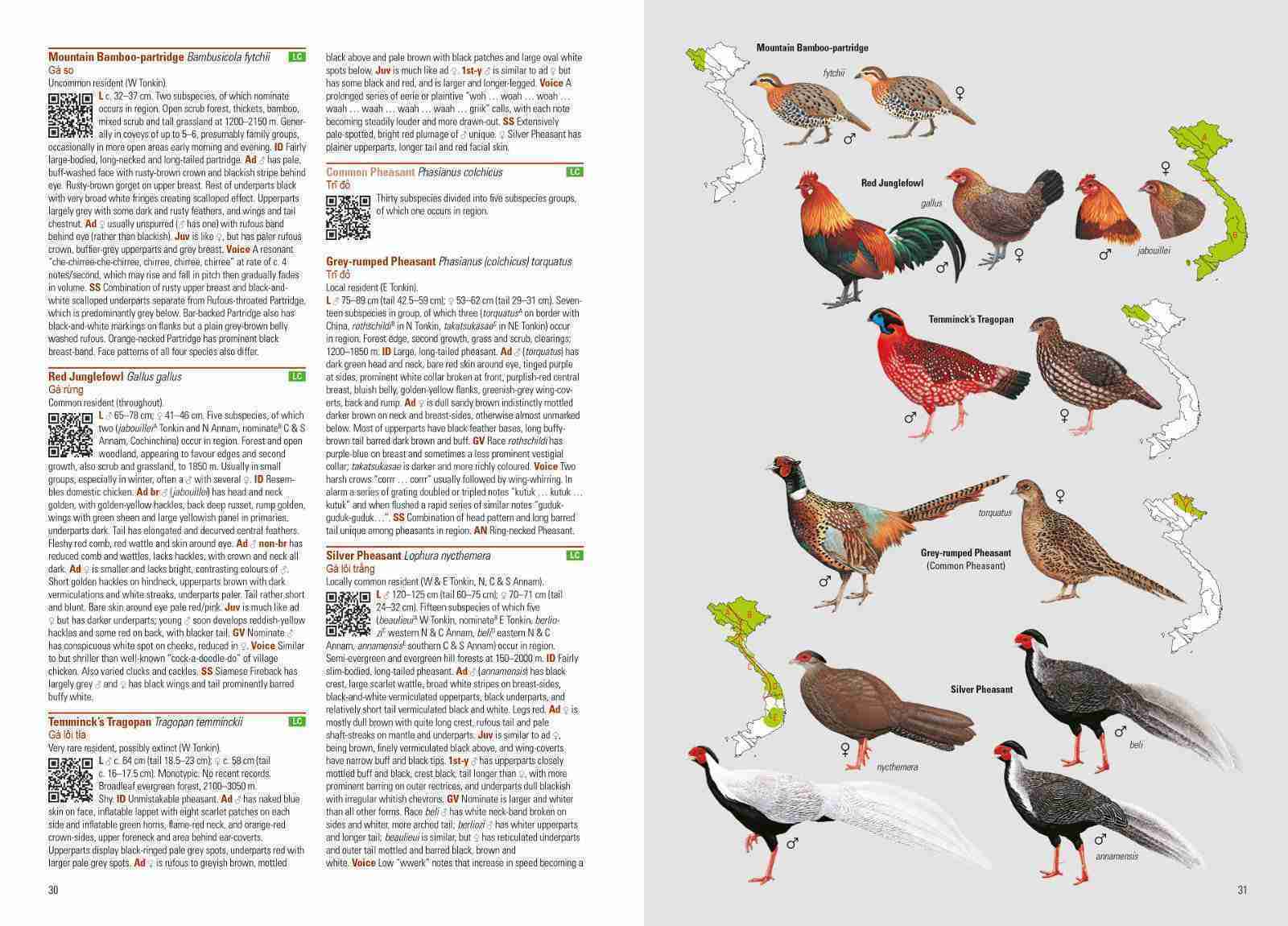
The Phasianidae are a family of terrestrial birds which consists of quails, partridges, snowcocks, francolins, spurfowls, tragopans, monals, pheasants, peafowls and jungle fowls. In general, they are plump (although they vary in size) and have broad, relatively short wings.
Grebes
Order: Podicipediformes Family: Podicipedidae
Grebes are small to medium-large freshwater diving birds. They have lobed toes and are excellent swimmers and divers. However, they have their feet placed far back on the body, making them quite ungainly on land.
- Little grebe, Tachybaptus ruficollis
- Great crested grebe, Podiceps cristatus (A)
- Eared grebe, Podiceps nigricollis (A)
Pigeons and doves
Order: Columbiformes Family: Columbidae
Pigeons and doves are stout-bodied birds with short necks and short slender bills with a fleshy cere.
Bustards
Order: Otidiformes Family: Otididae
Bustards are large terrestrial birds mainly associated with dry open country and steppes in the Old World. They are omnivorous and nest on the ground. They walk steadily on strong legs and big toes, pecking for food as they go. They have long broad wings with "fingered" wingtips and striking patterns in flight. Many have interesting mating displays.
- Bengal florican, Houbaropsis bengalensis
Cuckoos
Order: Cuculiformes Family: Cuculidae
The family Cuculidae includes cuckoos, roadrunners and anis. These birds are of variable size with slender bodies, long tails and strong legs. The Old World cuckoos are brood parasites.
Frogmouths
Order: Caprimulgiformes Family: Podargidae
The frogmouths are a group of nocturnal birds related to the nightjars. They are named for their large flattened hooked bill and huge frog-like gape, which they use to take insects.
- Hodgson's frogmouth, Batrachostomus hodgsoni
- Blyth's frogmouth, Batrachostomus affinis
Nightjars and allies
Order: Caprimulgiformes Family: Caprimulgidae
Nightjars are medium-sized nocturnal birds that usually nest on the ground. They have long wings, short legs and very short bills. Most have small feet, of little use for walking, and long pointed wings. Their soft plumage is camouflaged to resemble bark or leaves.
- Great eared-nightjar, Eurostopodus macrotis
- Gray nightjar, Caprimulgus jotaka
- Large-tailed nightjar, Caprimulgus macrurus
- Indian nightjar, Caprimulgus asiaticus
- Savanna nightjar, Caprimulgus affinis
Swifts
Order: Caprimulgiformes Family: Apodidae
Swifts are small birds which spend the majority of their lives flying. These birds have very short legs and never settle voluntarily on the ground, perching instead only on vertical surfaces. Many swifts have long swept-back wings which resemble a crescent or boomerang.
- White-throated needletail, Hirundapus caudacutus
- Silver-backed needletail, Hirundapus cochinchinensis
- Brown-backed needletail, Hirundapus giganteus
- Himalayan swiftlet, Aerodramus brevirostris
- Black-nest swiftlet, Aerodramus maximus
- White-nest swiftlet, Aerodramus fuciphagus
- German's swiftlet, Aerodramus germani
- Pacific swift, Apus pacificus
- Cook's swift, Apus cooki
- House swift, Apus nipalensis
- Asian palm-swift, Cypsiurus balasiensis
Treeswifts
Order: Caprimulgiformes Family: Hemiprocnidae
The treeswifts, also called crested swifts, are closely related to the true swifts. They differ from the other swifts in that they have crests, long forked tails and softer plumage.
- Crested treeswift, Hemiprocne coronata
Rails, gallinules and coots
Order: Gruiformes Family: Rallidae
Rallidae is a large family of small to medium-sized birds which includes the rails, crakes, coots and gallinules. Typically they inhabit dense vegetation in damp environments near lakes, swamps or rivers. In general they are shy and secretive birds, making them difficult to observe. Most species have strong legs and long toes which are well adapted to soft uneven surfaces. They tend to have short, rounded wings and to be weak fliers.
Finfoots
Order: Gruiformes Family: Heliornithidae
Heliornithidae is a small family of tropical birds with webbed lobes on their feet similar to those of grebes and coots.
- Masked finfoot, Heliopais personata
Cranes
Order: Gruiformes Family: Gruidae
Cranes are large, long-legged and long-necked birds. Unlike the similar-looking but unrelated herons, cranes fly with necks outstretched, not pulled back. Most have elaborate and noisy courting displays or "dances".
- Sarus crane, Antigone antigone
- Common crane, Grus grus
- Black-necked crane, Grus nigricollis
Thick-knees
Order: Charadriiformes Family: Burhinidae
The thick-knees are a group of largely tropical waders in the family Burhinidae. They are found worldwide within the tropical zone, with some species also breeding in temperate Europe and Australia. They are medium to large waders with strong black or yellow-black bills, large yellow eyes and cryptic plumage. Despite being classed as waders, most species have a preference for arid or semi-arid habitats.
- Indian thick-knee, Burhinus indicus
- Great thick-knee, Esacus recurvirostris
Stilts and avocets
Order: Charadriiformes Family: Recurvirostridae
Recurvirostridae is a family of large wading birds, which includes the avocets and stilts. The avocets have long legs and long up-curved bills. The stilts have extremely long legs and long, thin, straight bills.
- Black-winged stilt, Himantopus himantopus
- Pied avocet, Recurvirostra avosetta (A)
Oystercatchers
Order: Charadriiformes Family: Haematopodidae
The oystercatchers are large and noisy plover-like birds, with strong bills used for smashing or prising open molluscs.
- Eurasian oystercatcher, Haematopus ostralegus (A)
Plovers and lapwings
Order: Charadriiformes Family: Charadriidae
The family Charadriidae includes the plovers, dotterels and lapwings. They are small to medium-sized birds with compact bodies, short, thick necks and long, usually pointed, wings. They are found in open country worldwide, mostly in habitats near water.
- Black-bellied plover, Pluvialis squatarola
- Pacific golden-plover, Pluvialis fulva
- Northern lapwing, Vanellus vanellus
- River lapwing, Vanellus duvaucelii
- Gray-headed lapwing, Vanellus cinereus
- Red-wattled lapwing, Vanellus indicus
- Lesser sand-plover, Charadrius mongolus
- Greater sand-plover, Charadrius leschenaultii
- Malaysian plover, Charadrius peronii
- Kentish plover, Charadrius alexandrinus
- White-faced plover, Charadrius dealbatus
- Common ringed plover, Charadrius hiaticula (A)
- Long-billed plover, Charadrius placidus
- Little ringed plover, Charadrius dubius
- Oriental plover, Charadrius veredus
Painted-snipes
Order: Charadriiformes Family: Rostratulidae
Painted-snipes are short-legged, long-billed birds similar in shape to the true snipes, but more brightly coloured.
- Greater painted-snipe, Rostratula benghalensis
Jacanas
Order: Charadriiformes Family: Jacanidae
The jacanas are a group of tropical waders in the family Jacanidae. They are found throughout the tropics. They are identifiable by their huge feet and claws which enable them to walk on floating vegetation in the shallow lakes that are their preferred habitat.
- Pheasant-tailed jacana, Hydrophasianus chirurgus
- Bronze-winged jacana, Metopidius indicus
Sandpipers and allies
Order: Charadriiformes Family: Scolopacidae
Scolopacidae is a large diverse family of small to medium-sized shorebirds including the sandpipers, curlews, godwits, shanks, tattlers, woodcocks, snipes, dowitchers and phalaropes. The majority of these species eat small invertebrates picked out of the mud or soil. Variation in length of legs and bills enables multiple species to feed in the same habitat, particularly on the coast, without direct competition for food.
Buttonquail
Order: Charadriiformes Family: Turnicidae
The buttonquail are small, drab, running birds which resemble the true quails. The female is the brighter of the sexes and initiates courtship. The male incubates the eggs and tends the young.
- Small buttonquail, Turnix sylvatica
- Yellow-legged buttonquail, Turnix tanki
- Barred buttonquail, Turnix suscitator
Pratincoles and coursers
Order: Charadriiformes Family: Glareolidae
Glareolidae is a family of wading birds comprising the pratincoles, which have short legs, long pointed wings and long forked tails, and the coursers, which have long legs, short wings and long, pointed bills which curve downwards.
- Oriental pratincole, Glareola maldivarum
- Small pratincole, Glareola lactea (A)
Skuas and jaegers
Order: Charadriiformes Family: Stercorariidae
The family Stercorariidae are, in general, medium to large birds, typically with grey or brown plumage, often with white markings on the wings. They nest on the ground in temperate and arctic regions and are long-distance migrants.
- Pomarine jaeger, Stercorarius pomarinus
- Parasitic jaeger, Stercorarius parasiticus
Auks, murres, and puffins
Order: Charadriiformes Family: Alcidae
Alcids are superficially similar to penguins due to their black-and-white colors, their upright posture and some of their habits, however they are not related to the penguins and differ in being able to fly. Auks live on the open sea, only deliberately coming ashore to nest.
- Ancient murrelet, Synthliboramphus antiquus (A)
Gulls, terns, and skimmers
Order: Charadriiformes Family: Laridae
Laridae is a family of medium to large seabirds, the gulls, terns, and skimmers. Gulls are typically grey or white, often with black markings on the head or wings. They have stout, longish bills and webbed feet. Terns are a group of generally medium to large seabirds typically with grey or white plumage, often with black markings on the head. Most terns hunt fish by diving but some pick insects off the surface of fresh water. Terns are generally long-lived birds, with several species known to live in excess of 30 years.
Tropicbirds
Order: Phaethontiformes Family: Phaethontidae
Tropicbirds are slender white birds of tropical oceans, with exceptionally long central tail feathers. Their heads and long wings have black markings.
- Red-billed tropicbird, Phaethon aethereus
Northern storm-petrels
Order: Procellariiformes Family: Hydrobatidae
The northern storm-petrels are relatives of the petrels and are the smallest seabirds. They feed on planktonic crustaceans and small fish picked from the surface, typically while hovering. The flight is fluttering and sometimes bat-like.
- Swinhoe's storm-petrel, Hydrobates monorhis
Shearwaters and petrels
Order: Procellariiformes Family: Procellariidae
The procellariids are the main group of medium-sized "true petrels", characterized by united nostrils with medium septum and a long outer functional primary.
- Streaked shearwater, Calonectris leucomelas (A)
- Wedge-tailed shearwater, Ardenna pacifica (A)
- Christmas shearwater, Puffinus nativitatis (A)
Storks
Order: Ciconiiformes Family: Ciconiidae
Storks are large, long-legged, long-necked, wading birds with long, stout bills. Storks are mute, but bill-clattering is an important mode of communication at the nest. Their nests can be large and may be reused for many years. Many species are migratory.
- Asian openbill, Anastomus oscitans
- Black stork, Ciconia nigra
- Asian woolly-necked stork, Ciconia episcopus
- Black-necked stork, Ephippiorhynchus asiaticus
- Lesser adjutant, Leptoptilos javanicus
- Greater adjutant, Leptoptilos dubius
- Milky stork, Mycteria cinerea
- Painted stork, Mycteria leucocephala
Frigatebirds
Order: Suliformes Family: Fregatidae
Frigatebirds are large seabirds usually found over tropical oceans. They are large, black-and-white or completely black, with long wings and deeply forked tails. The males have coloured inflatable throat pouches. They do not swim or walk and cannot take off from a flat surface. Having the largest wingspan-to-body-weight ratio of any bird, they are essentially aerial, able to stay aloft for more than a week.
- Lesser frigatebird, Fregata ariel (A)
- Christmas Island frigatebird, Fregata andrewsi (A)
- Great frigatebird, Fregata minor (A)
Boobies and gannets
Order: Suliformes Family: Sulidae
The sulids comprise the gannets and boobies. Both groups are medium to large coastal seabirds that plunge-dive for fish.
- Masked booby, Sula dactylatra (A)
- Brown booby, Sula leucogaster
- Red-footed booby, Sula sula
Anhingas
Order: Suliformes Family: Anhingidae
Anhingas or darters are often called "snake-birds" because of their long thin neck, which gives a snake-like appearance when they swim with their bodies submerged. The males have black and dark-brown plumage, an erectile crest on the nape and a larger bill than the female. The females have much paler plumage especially on the neck and underparts. The darters have completely webbed feet and their legs are short and set far back on the body. Their plumage is somewhat permeable, like that of cormorants, and they spread their wings to dry after diving.
- Oriental darter, Anhinga melanogaster
Cormorants and shags
Order: Suliformes Family: Phalacrocoracidae
Phalacrocoracidae is a family of medium to large coastal, fish-eating seabirds that includes cormorants and shags. Plumage colouration varies, with the majority having mainly dark plumage, some species being black-and-white and a few being colourful.
- Little cormorant, Microcarbo niger
- Great cormorant, Phalacrocorax carbo
- Indian cormorant, Phalacrocorax fuscicollis
Pelicans
Order: Pelecaniformes Family: Pelecanidae
Pelicans are large water birds with a distinctive pouch under their beak. As with other members of the order Pelecaniformes, they have webbed feet with four toes.
- Great white pelican, Pelecanus onocrotalus (A)
- Spot-billed pelican, Pelecanus philippensis (A)
Herons, egrets, and bitterns
Order: Pelecaniformes Family: Ardeidae
The family Ardeidae contains the bitterns, herons and egrets. Herons and egrets are medium to large wading birds with long necks and legs. Bitterns tend to be shorter necked and more wary. Members of Ardeidae fly with their necks retracted, unlike other long-necked birds such as storks, ibises and spoonbills.
Ibises and spoonbills
Order: Pelecaniformes Family: Threskiornithidae
Threskiornithidae is a family of large terrestrial and wading birds which includes the ibises and spoonbills. They have long, broad wings with 11 primary and about 20 secondary feathers. They are strong fliers and despite their size and weight, very capable soarers.
- Glossy ibis, Plegadis falcinellus
- Black-headed ibis, Threskiornis melanocephalus
- White-shouldered ibis, Pseudibis davisoni (Ex)
- Giant ibis, Pseudibis gigantea (A)
- Eurasian spoonbill, Platalea leucorodia (A)
- Black-faced spoonbill, Platalea minor
Osprey
Order: Accipitriformes Family: Pandionidae
The family Pandionidae contains only one species, the osprey. The osprey is a medium-large raptor which is a specialist fish-eater with a worldwide distribution.
- Osprey, Pandion haliaetus
Hawks, eagles, and kites
Order: Accipitriformes Family: Accipitridae
Accipitridae is a family of birds of prey, which includes hawks, eagles, kites, harriers and Old World vultures. These birds have powerful hooked beaks for tearing flesh from their prey, strong legs, powerful talons and keen eyesight.
Barn-owls
Order: Strigiformes Family: Tytonidae
Barn owls are medium to large owls with large heads and characteristic heart-shaped faces. They have long strong legs with powerful talons.
- Australasian grass-owl, Tyto longimembris
- Eastern barn owl, Tyto javanica
- Oriental bay-owl, Phodilus badius
Owls
Order: Strigiformes Family: Strigidae
The typical owls are small to large solitary nocturnal birds of prey. They have large forward-facing eyes and ears, a hawk-like beak and a conspicuous circle of feathers around each eye called a facial disk.
Trogons
Order: Trogoniformes Family: Trogonidae
The family Trogonidae includes trogons and quetzals. Found in tropical woodlands worldwide, they feed on insects and fruit, and their broad bills and weak legs reflect their diet and arboreal habits. Although their flight is fast, they are reluctant to fly any distance. Trogons have soft, often colourful, feathers with distinctive male and female plumage.
- Red-headed trogon, Harpactes erythrocephalus
- Orange-breasted trogon, Harpactes oreskios
- Ward's trogon, Harpactes wardi
Hoopoes
Order: Bucerotiformes Family: Upupidae
Hoopoes have black, white and orangey-pink colouring with a large erectile crest on their head.
- Eurasian hoopoe, Upupa epops
Hornbills
Order: Bucerotiformes Family: Bucerotidae
Hornbills are a group of birds whose bill is shaped like a cow's horn, but without a twist, sometimes with a casque on the upper mandible. Frequently, the bill is brightly coloured.
- White-crowned hornbill, Berenicornis comatus
- Great hornbill, Buceros bicornis
- Brown hornbill, Anorrhinus austeni
- Black hornbill, Anthracoceros malayanus
- Oriental pied-hornbill, Anthracoceros albirostris
- Rufous-necked hornbill, Aceros nipalensis
- Wreathed hornbill, Rhyticeros undulatus
Kingfishers
Order: Coraciiformes Family: Alcedinidae
Kingfishers are medium-sized birds with large heads, long, pointed bills, short legs and stubby tails.
- Blyth's kingfisher, Alcedo hercules
- Common kingfisher, Alcedo atthis
- Blue-eared kingfisher, Alcedo meninting
- Black-backed dwarf-kingfisher, Ceyx erithaca
- Banded kingfisher, Lacedo pulchella
- Stork-billed kingfisher, Pelargopsis capensis
- Ruddy kingfisher, Halcyon coromanda
- White-throated kingfisher, Halcyon smyrnensis
- Black-capped kingfisher, Halcyon pileata
- Collared kingfisher, Todirhamphus chloris
- Crested kingfisher, Megaceryle lugubris
- Pied kingfisher, Ceryle rudis
Bee-eaters
Order: Coraciiformes Family: Meropidae
The bee-eaters are a group of near passerine birds in the family Meropidae. Most species are found in Africa but others occur in southern Europe, Madagascar, Australia and New Guinea. They are characterised by richly coloured plumage, slender bodies and usually elongated central tail feathers. All are colourful and have long downturned bills and pointed wings, which give them a swallow-like appearance when seen from afar.
- Blue-bearded bee-eater, Nyctyornis athertoni
- Asian green bee-eater, Merops orientalis
- Blue-throated bee-eater, Merops viridis
- Blue-tailed bee-eater, Merops philippinus
- Chestnut-headed bee-eater, Merops leschenaultia
Rollers
Order: Coraciiformes Family: Coraciidae
Rollers resemble crows in size and build, but are more closely related to the kingfishers and bee-eaters. They share the colourful appearance of those groups with blues and browns predominating. The two inner front toes are connected, but the outer toe is not.
- Indochinese roller, Coracias affinis
- Dollarbird, Eurystomus orientalis
Asian barbets
Order: Piciformes Family: Megalaimidae
The Asian barbets are plump birds, with short necks and large heads. They get their name from the bristles which fringe their heavy bills. Most species are brightly coloured.
- Coppersmith barbet, Psilopogon haemacephalus
- Blue-eared barbet, Psilopogon duvaucelii
- Great barbet, Psilopogon virens
- Red-vented barbet, Psilopogon lagrandieri
- Green-eared barbet, Psilopogon faiostrictus
- Lineated barbet, Psilopogon lineatus
- Golden-throated barbet, Psilopogon franklinii
- Necklaced barbet, Psilopogon auricularis
- Moustached barbet, Psilopogon incognitus
- Blue-throated barbet, Psilopogon asiaticus
- Indochinese barbet, Psilopogon annamensis
Woodpeckers
Order: Piciformes Family: Picidae
Woodpeckers are small to medium-sized birds with chisel-like beaks, short legs, stiff tails and long tongues used for capturing insects. Some species have feet with two toes pointing forward and two backward, while several species have only three toes. Many woodpeckers have the habit of tapping noisily on tree trunks with their beaks.
Falcons
Order: Falconiformes Family: Falconidae
Falconidae is a family of diurnal birds of prey. They differ from hawks, eagles and kites in that they kill with their beaks instead of their talons.
- White-rumped falcon, Polihierax insignis
- Collared falconet, Microhierax caerulescens
- Pied falconet, Microhierax melanoleucus
- Eurasian kestrel, Falco tinnunculus
- Amur falcon, Falco amurensis
- Merlin, Falco columbarius (A)
- Eurasian hobby, Falco subbuteo
- Oriental hobby, Falco severus
- Laggar falcon, Falco jugger
- Peregrine falcon, Falco peregrinus
Old World parrots
Order: Psittaciformes Family: Psittaculidae
Parrots are small to large birds with a characteristic curved beak. Their upper mandibles have slight mobility in the joint with the skull and they have a generally erect stance. All parrots are zygodactyl, having the four toes on each foot placed two at the front and two to the back.
- Blue-rumped parrot, Psittinus cyanurus
- Alexandrine parakeet, Psittacula eupatria
- Rose-ringed parakeet, Psittacula krameri (I)
- Gray-headed parakeet, Psittacula finschii
- Blossom-headed parakeet, Psittacula roseata
- Red-breasted parakeet, Psittacula alexandri
- Long-tailed parakeet, Psittacula longicauda
- Vernal hanging-parrot, Loriculus vernalis
Asian and Grauer's broadbills
Order: Passeriformes Family: Eurylaimidae
The broadbills are small, brightly coloured birds, which feed on fruit and also take insects in flycatcher fashion, snapping their broad bills. Their habitat is canopies of wet forests.
- Black-and-red broadbill, Cymbirhynchus macrorhynchos
- Long-tailed broadbill, Psarisomus dalhousiae
- Silver-breasted broadbill, Serilophus lunatus
- Banded broadbill, Eurylaimus javanicus
- Dusky broadbill, Corydon sumatranus
Pittas
Order: Passeriformes Family: Pittidae
Pittas are medium-sized by passerine standards and are stocky, with fairly long, strong legs, short tails and stout bills. Many are brightly coloured. They spend the majority of their time on wet forest floors, eating snails, insects and similar invertebrates.
- Eared pitta, Hydrornis phayrei
- Rusty-naped pitta, Hydrornis oatesi
- Blue-naped pitta, Hydrornis nipalensis
- Blue-rumped pitta, Hydrornis soror
- Blue pitta, Hydrornis cyanea
- Bar-bellied pitta, Hydrornis elliotii
- Blue-winged pitta, Pitta moluccensis
- Fairy pitta, Pitta nympha
- Hooded pitta, Pitta sordida
Thornbills and allies
Order: Passeriformes Family: Acanthizidae
Thornbills are small passerine birds, similar in habits to the tits.
- Golden-bellied gerygone, Gerygone sulphurea
Cuckooshrikes
Order: Passeriformes Family: Campephagidae
The cuckooshrikes are small to medium-sized passerine birds. They are predominantly greyish with white and black, although some species are brightly coloured.
- Small minivet, Pericrocotus cinnamomeus
- Gray-chinned minivet, Pericrocotus solaris
- Short-billed minivet, Pericrocotus brevirostris
- Long-tailed minivet, Pericrocotus ethologus
- Scarlet minivet, Pericrocotus flammeus
- Ashy minivet, Pericrocotus divaricatus
- Brown-rumped minivet, Pericrocotus cantonensis
- Rosy minivet, Pericrocotus roseus
- Large cuckooshrike, Coracina macei
- Black-winged cuckooshrike, Lalage melaschistos
- Indochinese cuckooshrike, Lalage polioptera
Vireos, shrike-babblers, and erpornis
Order: Passeriformes Family: Vireonidae
Most of the members of this family are found in the New World. However, the shrike-babblers and erpornis, which only slightly resemble the "true" vireos and greenlets, are found in South East Asia.
- Black-headed shrike-babbler, Pteruthius rufiventer
- White-browed shrike-babbler, Pteruthius aeralatus
- Green shrike-babbler, Pteruthius xanthochlorus (A)
- Black-eared shrike-babbler, Pteruthius melanotis
- Clicking shrike-babbler, Pteruthius intermedius
- White-bellied erpornis, Erpornis zantholeuca
Whistlers
Order: Passeriformes Family: Pachycephalidae
The family Pachycephalidae includes the whistlers, shrikethrushes, shrikethrushes, and some of the pitohuis.
- Mangrove whistler, Pachycephala cinerea
Old World orioles
Order: Passeriformes Family: Oriolidae
The Old World orioles are colourful passerine birds. They are not related to the New World orioles.
- Black-naped oriole, Oriolus chinensis
- Slender-billed oriole, Oriolus tenuirostris
- Black-hooded oriole, Oriolus xanthornus
- Maroon oriole, Oriolus traillii
- Silver oriole, Oriolus mellianus (A)
Woodswallows
Order: Passeriformes Family: Artamidae
The woodswallows are soft-plumaged, somber-coloured passerine birds. They are smooth, agile flyers with moderately large, semi-triangular wings.
- Ashy woodswallow, Artamus fuscus
Vangas, helmetshrikes, and allies
Order: Passeriformes Family: Vangidae
The family Vangidae is highly variable, though most members of it resemble true shrikes to some degree.
- Large woodshrike, Tephrodornis gularis
- Common woodshrike, Tephrodornis pondicerianus
- Bar-winged flycatcher-shrike, Hemipus picatus
Ioras
Order: Passeriformes Family: Aegithinidae
The ioras are bulbul-like birds of open forest or thorn scrub, but whereas that group tends to be drab in colouration, ioras are sexually dimorphic, with the males being brightly plumaged in yellows and greens.
- Common iora, Aegithina tiphia
- Great iora, Aegithina lafresnayei
Fantails
Order: Passeriformes Family: Rhipiduridae
The fantails are small insectivorous birds which are specialist aerial feeders.
- Malaysian pied-fantail, Rhipidura javanica
- White-throated fantail, Rhipidura albicollis
- White-browed fantail, Rhipidura aureola
Drongos
Order: Passeriformes Family: Dicruridae
The drongos are mostly black or dark grey in colour, sometimes with metallic tints. They have long forked tails, and some Asian species have elaborate tail decorations. They have short legs and sit very upright when perched, like a shrike. They flycatch or take prey from the ground.
- Black drongo, Dicrurus macrocercus
- Ashy drongo, Dicrurus leucophaeus
- Crow-billed drongo, Dicrurus annectens
- Bronzed drongo, Dicrurus aeneus
- Lesser racket-tailed drongo, Dicrurus remifer
- Hair-crested drongo, Dicrurus hottentottus
- Greater racket-tailed drongo, Dicrurus paradiseus
Monarch flycatchers
Order: Passeriformes Family: Monarchidae
The monarch flycatchers are small to medium-sized insectivorous passerines which hunt by flycatching.
- Black-naped monarch, Hypothymis azurea
- Japanese paradise-flycatcher, Terpsiphone atrocaudata
- Amur paradise-flycatcher, Terpsiphone incei
- Blyth's paradise-flycatcher, Terpsiphone affinis
Shrikes
Order: Passeriformes Family: Laniidae
Shrikes are passerine birds known for their habit of catching other birds and small animals and impaling the uneaten portions of their bodies on thorns. A typical shrike's beak is hooked, like a bird of prey.
- Tiger shrike, Lanius tigrinus
- Bull-headed shrike, Lanius bucephalus (A)
- Brown shrike, Lanius cristatus
- Burmese shrike, Lanius collurioides
- Long-tailed shrike, Lanius schach
- Gray-backed shrike, Lanius tephronotus
Crows, jays, and magpies
Order: Passeriformes Family: Corvidae
The family Corvidae includes crows, ravens, jays, choughs, magpies, treepies, nutcrackers and ground jays. Corvids are above average in size among the Passeriformes, and some of the larger species show high levels of intelligence.
Fairy flycatchers
Order: Passeriformes Family: Stenostiridae
Most of the species of this small family are found in Africa, though a few inhabit tropical Asia. They are not closely related to other birds called "flycatchers".
- Yellow-bellied fairy-fantail, Chelidorhynx hypoxanthus
- Gray-headed canary-flycatcher, Culicicapa ceylonensis
Tits, chickadees, and titmice
Order: Passeriformes Family: Paridae
The Paridae are mainly small stocky woodland species with short stout bills. Some have crests. They are adaptable birds, with a mixed diet including seeds and insects.
- Yellow-browed tit, Sylviparus modestus
- Sultan tit, Melanochlora sultanea
- Green-backed tit, Parus monticolus
- Cinereous tit, Parus cinereus
- Japanese tit, Parus minor
- Yellow-cheeked tit, Machlolophus spilonotus
Penduline-tits
Order: Passeriformes Family: Remizidae
The penduline-tits are a group of small passerine birds related to the true tits. They are insectivores.
- Chinese penduline-tit, Remiz consobrinus (A)
Larks
Order: Passeriformes Family: Alaudidae
Larks are small terrestrial birds with often extravagant songs and display flights. Most larks are fairly dull in appearance. Their food is insects and seeds.
- Horsfield's bushlark, Mirafra javanica
- Indochinese bushlark, Mirafra erythrocephala
- Asian short-toed lark, Alaudala cheleensis (A)
- Oriental skylark, Alauda gulgula
Cisticolas and allies
Order: Passeriformes Family: Cisticolidae
The Cisticolidae are warblers found mainly in warmer southern regions of the Old World. They are generally very small birds of drab brown or grey appearance found in open country such as grassland or scrub.
- Common tailorbird, Orthotomus sutorius
- Dark-necked tailorbird, Orthotomus atrogularis
- Ashy tailorbird, Orthotomus ruficeps
- Annam prinia, Prinia rocki (E)
- Brown prinia, Prinia polychroa
- Hill prinia, Prinia superciliaris
- Rufescent prinia, Prinia rufescens
- Gray-breasted prinia, Prinia hodgsonii
- Yellow-bellied prinia, Prinia flaviventris
- Plain prinia, Prinia inornata
- Zitting cisticola, Cisticola juncidis
- Golden-headed cisticola, Cisticola exilis
Reed warblers and allies
Order: Passeriformes Family: Acrocephalidae
The members of this family are usually rather large for "warblers". Most are rather plain olivaceous brown above with much yellow to beige below. They are usually found in open woodland, reedbeds, or tall grass. The family occurs mostly in southern to western Eurasia and surroundings, but it also ranges far into the Pacific, with some species in Africa.
- Thick-billed warbler, Arundinax aedon
- Black-browed reed warbler, Acrocephalus bistrigiceps
- Paddyfield warbler, Acrocephalus agricola (A)
- Blunt-winged warbler, Acrocephalus concinens
- Manchurian reed warbler, Acrocephalus tangorum
- Oriental reed warbler, Acrocephalus orientalis
- Clamorous reed warbler, Acrocephalus stentoreus
Grassbirds and allies
Order: Passeriformes Family: Locustellidae
Locustellidae are a family of small insectivorous songbirds found mainly in Eurasia, Africa, and the Australian region. They are smallish birds with tails that are usually long and pointed, and tend to be drab brownish or buffy all over.
- Striated grassbird, Megalurus palustris
- Pallas's grasshopper warbler, Helopsaltes certhiola
- Pleske's grasshopper warbler, Helopsaltes pleskei
- Lanceolated warbler, Locustella lanceolata
- Brown bush warbler, Locustella luteoventris
- Chinese bush warbler, Locustella tacsanowskia
- Baikal bush warbler, Locustella davidi
- Russet bush warbler, Locustella mendelli
- Dalat bush warbler, Locustella idonea (E)
Cupwings
Order: Passeriformes Family: Pnoepygidae
The members of this small family are found in mountainous parts of South and South East Asia.
- Scaly-breasted cupwing, Pnoepyga albiventer
- Pygmy cupwing, Pnoepyga pusilla
Swallows
Order: Passeriformes Family: Hirundinidae
The family Hirundinidae is adapted to aerial feeding. They have a slender streamlined body, long pointed wings and a short bill with a wide gape. The feet are adapted to perching rather than walking, and the front toes are partially joined at the base.
- Gray-throated martin, Riparia chinensis
- Bank swallow, Riparia riparia
- Dusky crag-martin, Ptyonoprogne concolor
- Barn swallow, Hirundo rustica
- Wire-tailed swallow, Hirundo smithii
- Pacific swallow, Hirundo tahitica
- Red-rumped swallow, Cecropis daurica
- Striated swallow, Cecropis striolata
- Rufous-bellied swallow, Cecropis badia
- Common house-martin, Delichon urbicum
- Asian house-martin, Delichon dasypus
- Nepal house-martin, Delichon nipalense
Bulbuls
Order: Passeriformes Family: Pycnonotidae
Bulbuls are medium-sized songbirds. Some are colourful with yellow, red or orange vents, cheeks, throats or supercilia, but most are drab, with uniform olive-brown to black plumage. Some species have distinct crests.
Leaf warblers
Order: Passeriformes Family: Phylloscopidae
Leaf warblers are a family of small insectivorous birds found mostly in Eurasia and ranging into Wallacea and Africa. The species are of various sizes, often green-plumaged above and yellow below, or more subdued with greyish-green to greyish-brown colours.
Bush warblers and allies
Order: Passeriformes Family: Scotocercidae
The members of this family are found throughout Africa, Asia, and Polynesia. Their taxonomy is in flux, and some authorities place some genera in other families.
- Pale-footed bush warbler, Urosphena pallidipes
- Asian stubtail, Urosphena squameiceps
- Gray-bellied tesia, Tesia cyaniventer
- Slaty-bellied tesia, Tesia olivea
- Chestnut-crowned bush warbler, Cettia major (A)
- Chestnut-headed tesia, Cettia castaneocoronata
- Yellow-bellied warbler, Abroscopus superciliaris
- Rufous-faced warbler, Abroscopus albogularis
- Black-faced warbler, Abroscopus schisticeps
- Mountain tailorbird, Phyllergates cuculatus
- Broad-billed warbler, Tickellia hodgsoni
- Manchurian bush warbler, Horornis borealis
- Brownish-flanked bush warbler, Horornis fortipes
- Aberrant bush warbler, Horornis flavolivaceus
Long-tailed tits
Order: Passeriformes Family: Aegithalidae
Long-tailed tits are a group of small passerine birds with medium to long tails. They make woven bag nests in trees. Most eat a mixed diet which includes insects.
- Black-throated tit, Aegithalos concinnus
Sylviid warblers, parrotbills, and allies
Order: Passeriformes Family: Sylviidae
The family Sylviidae is a group of small insectivorous passerine birds. They mainly occur as breeding species, as the common name implies, in Europe, Asia and, to a lesser extent, Africa. Most are of generally undistinguished appearance, but many have distinctive songs.
- Golden-breasted fulvetta, Lioparus chrysotis
- Yellow-eyed babbler, Chrysomma sinense
- Spectacled fulvetta, Fulvetta ruficapilla
- Indochinese fulvetta, Fulvetta danisi
- White-browed fulvetta, Fulvetta vinipectus
- Streak-throated fulvetta, Fulvetta manipurensis
- Gray-headed parrotbill, Psittiparus gularis
- Black-headed parrotbill, Psittiparus margaritae (E)
- Rufous-headed parrotbill, Psittiparus bakeri
- Spot-breasted parrotbill, Paradoxornis guttaticollis
- Pale-billed parrotbill, Chleuasicus atrosuperciliaris
- Vinous-throated parrotbill, Sinosuthora webbiana
- Ashy-throated parrotbill, Sinosuthora alphonsiana
- Black-throated parrotbill, Suthora nipalensis
- Golden parrotbill, Suthora verreauxi
- Short-tailed parrotbill, Neosuthora davidiana
White-eyes, yuhinas, and allies
Order: Passeriformes Family: Zosteropidae
The white-eyes are small and mostly undistinguished, their plumage above being generally some dull colour like greenish-olive, but some species have a white or bright yellow throat, breast or lower parts, and several have buff flanks. As their name suggests, many species have a white ring around each eye.
- White-collared yuhina, Parayuhina diademata
- Indochinese yuhina, Staphida torqueola
- Whiskered yuhina, Yuhina flavicollis
- Stripe-throated yuhina, Yuhina gularis
- Black-chinned yuhina, Yuhina nigrimenta
- Chestnut-flanked white-eye, Zosterops erythropleurus
- Indian white-eye, Zosterops palpebrosus
- Swinhoe's white-eye, Zosterops simplex
Tree-babblers, scimitar-babblers, and allies
Order: Passeriformes Family: Timaliidae
The babblers, or timaliids, are somewhat diverse in size and colouration, but are characterised by soft fluffy plumage.
Ground babblers and allies
Order: Passeriformes Family: Pellorneidae
These small to medium-sized songbirds have soft fluffy plumage but are otherwise rather diverse. Members of the genus Illadopsis are found in forests, but some other genera are birds of scrublands.
Laughingthrushes and allies
Order: Passeriformes Family: Leiothrichidae
The members of this family are diverse in size and colouration, though those of genus Turdoides tend to be brown or greyish. The family is found in Africa, India, and southeast Asia.
Wallcreeper
Order: Passeriformes Family: Tichodromidae
The wallcreeper is the only member of its family. It inhabits the high mountains of Eurasia from southern Europe to central China.
- Wallcreeper, Tichodroma muraria (A)
Nuthatches
Order: Passeriformes Family: Sittidae
Nuthatches are small woodland birds. They have the unusual ability to climb down trees head first, unlike other birds which can only go upwards. Nuthatches have big heads, short tails and powerful bills and feet.
- Chestnut-bellied nuthatch, Sitta castanea
- Burmese nuthatch, Sitta neglecta
- Chestnut-vented nuthatch, Sitta nagaensis
- White-tailed nuthatch, Sitta himalayensis
- Velvet-fronted nuthatch, Sitta frontalis
- Yellow-billed nuthatch, Sitta solangiae
- Beautiful nuthatch, Sitta formosa
Treecreepers
Order: Passeriformes Family: Certhiidae
Treecreepers are small woodland birds, brown above and white below. They have thin pointed down-curved bills, which they use to extricate insects from bark. They have stiff tail feathers, like woodpeckers, which they use to support themselves on vertical trees.
- Hume's treecreeper, Certhia manipurensis
Spotted elachura
Order: Passeriformes Family: Elachuridae
This species, the only one in its family, inhabits forest undergrowth throughout South East Asia.
- Spotted elachura, Elachura formosa
Dippers
Order: Passeriformes Family: Cinclidae
Dippers are a group of perching birds whose habitat includes aquatic environments in the Americas, Europe and Asia. They are named for their bobbing or dipping movements.
- Brown dipper, Cinclus pallasii
Starlings
Order: Passeriformes Family: Sturnidae
Starlings are small to medium-sized passerine birds. Their flight is strong and direct and they are very gregarious. Their preferred habitat is fairly open country. They eat insects and fruit. Plumage is typically dark with a metallic sheen.
Thrushes and allies
Order: Passeriformes Family: Turdidae
The thrushes are a group of passerine birds that occur mainly in the Old World. They are plump, soft plumaged, small to medium-sized insectivores or sometimes omnivores, often feeding on the ground. Many have attractive songs.
Old World flycatchers
Order: Passeriformes Family: Muscicapidae
Old World flycatchers are a large group of small passerine birds native to the Old World. They are mainly small arboreal insectivores. The appearance of these birds is highly varied, but they mostly have weak songs and harsh calls.
Flowerpeckers
Order: Passeriformes Family: Dicaeidae
The flowerpeckers are very small, stout, often brightly coloured birds, with short tails, short thick curved bills and tubular tongues.
- Scarlet-breasted flowerpecker, Prionochilus thoracicus
- Thick-billed flowerpecker, Dicaeum agile
- Yellow-vented flowerpecker, Dicaeum chrysorrheum
- Yellow-bellied flowerpecker, Dicaeum melanozanthum
- Orange-bellied flowerpecker, Dicaeum trigonostigma (A)
- Plain flowerpecker, Dicaeum minullum
- Fire-breasted flowerpecker, Dicaeum ignipectus
- Scarlet-backed flowerpecker, Dicaeum cruentatum
Sunbirds and spiderhunters
Order: Passeriformes Family: Nectariniidae
The sunbirds and spiderhunters are very small passerine birds which feed largely on nectar, although they will also take insects, especially when feeding young. Flight is fast and direct on their short wings. Most species can take nectar by hovering like a hummingbird, but usually perch to feed.
Fairy-bluebirds
Order: Passeriformes Family: Irenidae
The fairy-bluebirds are bulbul-like birds of open forest or thorn scrub. The males are dark-blue and the females a duller green.
- Asian fairy-bluebird, Irena puella
Leafbirds
Order: Passeriformes Family: Chloropseidae
The leafbirds are small, bulbul-like birds. The males are brightly plumaged, usually in greens and yellows.
- Blue-winged leafbird, Chloropsis cochinchinensis
- Golden-fronted leafbird, Chloropsis aurifrons
- Orange-bellied leafbird, Chloropsis hardwickii
Weavers and allies
Order: Passeriformes Family: Ploceidae
The weavers are small passerine birds related to the finches. They are seed-eating birds with rounded conical bills. The males of many species are brightly coloured, usually in red or yellow and black, some species show variation in colour only in the breeding season.
- Streaked weaver, Ploceus manyar
- Baya weaver, Ploceus philippinus
- Asian golden weaver, Ploceus hypoxanthus
Waxbills and allies
Order: Passeriformes Family: Estrildidae
The estrildid finches are small passerine birds of the Old World tropics and Australasia. They are gregarious and often colonial seed eaters with short thick but pointed bills. They are all similar in structure and habits, but have wide variation in plumage colours and patterns.
- Red avadavat, Amandava amandava
- Pin-tailed parrotfinch, Erythrura prasina
- White-rumped munia, Lonchura striata
- Scaly-breasted munia, Lonchura punctulata
- White-bellied munia, Lonchura leucogastra
- Chestnut munia, Lonchura atricapilla
- White-headed munia, Lonchura maja
- Java sparrow, Padda oryzivora (I)
Old World sparrows
Order: Passeriformes Family: Passeridae
Old World sparrows are small passerine birds. In general, sparrows tend to be small, plump, brown or grey birds with short tails and short powerful beaks. Sparrows are seed eaters, but they also consume small insects.
- House sparrow, Passer domesticus (I)
- Russet sparrow, Passer cinnamomeus
- Plain-backed sparrow, Passer flaveolus
- Eurasian tree sparrow, Passer montanus
Wagtails and pipits
Order: Passeriformes Family: Motacillidae
Motacillidae is a family of small passerine birds with medium to long tails. They include the wagtails, longclaws and pipits. They are slender, ground feeding insectivores of open country.
- Forest wagtail, Dendronanthus indicus
- Gray wagtail, Motacilla cinerea
- Western yellow wagtail, Motacilla flava
- Eastern yellow wagtail, Motacilla tschutschensis
- Citrine wagtail, Motacilla citreola
- Mekong wagtail, Motacilla samveasnae
- White wagtail, Motacilla alba
- Richard's pipit, Anthus richardi
- Paddyfield pipit, Anthus rufulus
- Upland pipit, Anthus sylvanus (A)
- Rosy pipit, Anthus roseatus
- Olive-backed pipit, Anthus hodgsoni
- Red-throated pipit, Anthus cervinus
- Water pipit, Anthus spinoletta
- American pipit, Anthus rubescens (A)
Finches, euphonias, and allies
Order: Passeriformes Family: Fringillidae
Finches are seed-eating passerine birds, that are small to moderately large and have a strong beak, usually conical and in some species very large. All have twelve tail feathers and nine primaries. These birds have a bouncing flight with alternating bouts of flapping and gliding on closed wings, and most sing well.
Old World buntings
Order: Passeriformes Family: Emberizidae
The emberizids are a large family of passerine birds. They are seed-eating birds with distinctively shaped bills. Many emberizid species have distinctive head patterns.
See also
- List of birds
- Lists of birds by region
Notes
References
- Lepage, Denis. "Checklist of Birds of Vietnam". Bird Checklists of the World. Avibase. Retrieved 27 January 2020.
- Clements, James F. (2000). Birds of the World: A Checklist. Cornell University Press. p. 880. ISBN 0-934797-16-1.
External links
- Multilingual list of birds of Vietnam - Includes equivalents in English, French, Chinese, Japanese, Thai, Malaysian and Indonesian